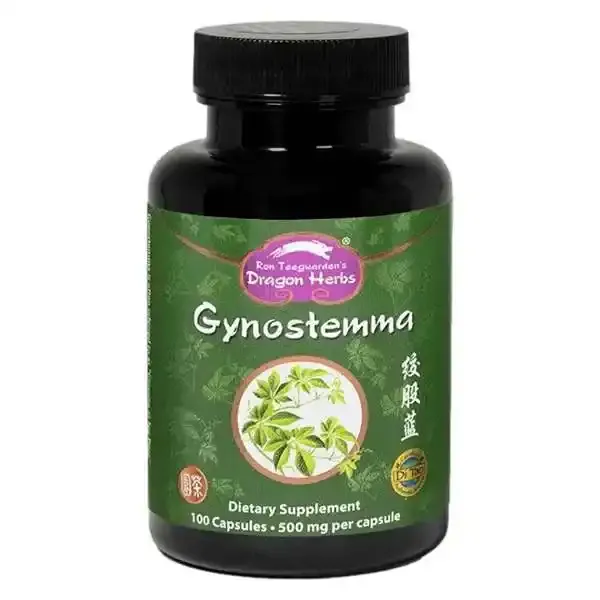
Dragon Herbs Gynostemma (100 Capsules)
SKU 1977
$25.00
Adaptogen
Premium Adaptogenic Gynostemma Capsules – Stress Resilience & Vitality Support
Estimated delivery time
Shipping: 4–8 days
In stock
Customer reviews
Reviews only from verified customers
No reviews yet. You can buy this product and be the first to leave a review.
Dragon Herbs Gynostemma (100 Capsules)
Product Details
UPC: 679372005342
Brand: Dragon Herbs
MPN: 534
GTIN: 00679372005342
Availability: Usually ships in 24-48 hours, M-F
Shipping: Calculated at Checkout
Bottle Size: Small (30-100)
Supplied In: Capsules
Oxidation Type: Everyone
Primary Function: Metabolic Support
Weight: 0.25 lbs
Dragon Herbs
Dragon Herbs Gynostemma (100 Capsules)
Gynostemma pentaphyllum — jiao gu lan in Chinese — grows wild in the mountains of southern China, where it has been drunk as a daily tea for centuries. The regions where it is most used have long been noted for the number of people who reach a great age in good health, which is how it came by its traditional name: the herb of immortality.
It is the herb we suggest most freely to people new to Chinese tonics, for a simple reason. It is genuinely hard to get wrong.
What makes Gynostemma unusual
Gynostemma contains a class of saponins called gypenosides. It is closely related to the ginsenosides in ginseng, but gynostemma carries considerably more of them — well over eighty identified compounds, against roughly thirty in ginseng. Several are identical to ginsenosides; others occur nowhere else.
What that produces is an adaptogen in the strict sense: a herb that moves you toward the middle rather than in one fixed direction. People who are wired and overstimulated tend to find it settling. People who are flat and depleted tend to find it lifting. That two-way quality is what the word adaptogen originally meant, and it is rarer than the marketing use of the word suggests.
It contains no caffeine and is not a stimulant. Whatever lift people report comes from supporting normal energy metabolism rather than from pushing the nervous system.
Cellular housekeeping and AMPK
The mechanism attracting the most research interest is gynostemma's effect on an enzyme called AMPK — adenosine monophosphate-activated protein kinase, the cell's master fuel gauge. AMPK activity rises when a cell's energy runs low, and it is the same switch that fasting and exercise flip.
One of the things AMPK activation turns on is autophagy, literally "self-eating". This is the body's ordinary housekeeping process for clearing out and recycling worn-out, damaged and abnormal cellular components — breaking them down into raw materials and building something useful from them. It runs constantly, it slows with age, and the 2016 Nobel Prize in Physiology or Medicine was awarded for working out how it operates.
In other words, gynostemma supports the mechanism the body already uses to recycle abnormal cells and keep normal cell growth in order. That is a normal maintenance process, not a treatment for anything, and it is worth being precise about the difference.
A Qi tonic that touches all three treasures
In traditional terms gynostemma is classed primarily as a Qi tonic — day-to-day functional energy — but it is one of the few herbs described as benefiting Shen as well, which is why it is associated with calm alertness rather than drive.
It is also traditionally used to support normal digestion and healthy respiratory function, and is one of the herbs most often taken as a simple daily tea rather than reserved for a course of treatment.
Suggested use
Two capsules, once or twice daily, or as directed by your healthcare practitioner. Tonic herbs are traditionally taken consistently over months rather than intensively over days — consistency matters far more here than dose.
How to read your dosage — the label is not always your dose
The bottle gives Dragon Herbs’ general serving suggestion. If you are working with a health provider, the schedule they set for you wins.
Schedules are written as three numbers — morning, noon and evening. For Dragon Herbs tonics the typical schedule is 3-0-3: three in the morning and three in the evening, none at midday, unless your health provider specifies otherwise.
| On your schedule | What it means |
|---|---|
| 3-0-3 | Three in the morning, three in the evening — the typical tonic schedule |
| 3-3-3 | Three with each of the three meals, nine a day in total |
Tonic herbs are traditionally taken over months rather than days, and the amount is adjusted to the person.
So do not work out how long a bottle will last from the label. Work it out from your schedule.
If you are not sure how to read your schedule, send it over — walking people through their own numbers is exactly what the text support is for.
About this formula
Traditional Function in Chinese Medicine
Dragon Herbs describes this formula’s traditional function as: “Tonifies Qi, clears heat, drains toxic heat, regulates metabolism. Enters the Lung and Heart meridians. Slightly bitter flavor. Cold temperature.”
Traditional-function language records how a formula is classified within Traditional Chinese Medicine. It describes the tradition, not a claim that this product diagnoses, treats, cures, or prevents any disease.
What a tonic herb is, and what it is not
Chinese tonic herbalism is a distinct tradition from the Western "take something for a symptom" model. Tonic herbs — the ones traditionally classed as superior — were selected over centuries for being safe enough to take daily over long periods, and are used to support the body’s own regulation rather than to push it in one direction.
That has a practical consequence worth setting expectations around: tonics are judged over months, not days. If you are looking for something that changes how you feel this afternoon, this is the wrong category.
Di Tao sourcing
Dragon Herbs works to a principle called Di Tao — that a herb should come from the region where it grows best, in the conditions it evolved for. It is the same idea as terroir in wine, and it matters more with herbs than most people expect: the same species grown in the wrong place produces a measurably different plant.
The three treasures
Traditional practice organises tonics into Jing (the deep reserve you are born with and spend over a lifetime), Qi (day-to-day functional energy) and Shen (spirit, presence, the quality of attention). Most formulas lean toward one. Knowing which one a formula addresses is the quickest way to tell whether it is the one you actually want.
From Eileen Durfee
Curated by Eileen Durfee — Inventor, Wellness Educator, 16 Patents
Gynostemma is the herb I recommend most freely, because it is the most adaptogenic thing in the line and genuinely hard to get wrong. If you want one Dragon Herbs product to start with, this is my answer.
I have studied nutritional balancing under Dr. Wilson since August 2011 and have practised independently since the autumn of 2017. The most useful thing I can offer is not a longer product list — it is help reading your own chart and adjusting between tests. Mineral patterns almost always shift on a retest, and watching that happen chart to chart is where the real learning is. I hand-select the formulas that consistently help people feel and function better.
How I am available to you. If you order a hair analysis, you get text support from me while you are on the program — retracing and detox questions are best answered as they happen, not weeks later. It takes about three months to train someone to understand what is going on and adjust their own program between tests, and that is the goal. Our Facebook group is free to join whether or not you have bought anything: ask questions there and read through the tips already shared.
I also work in order of priorities, to fit your budget. Some people go all out for longevity; others take only what their hair analysis calls for, once a day. Both are worth doing. Tell me where you are and we will start there.
Matched to your chart. Dragon Herbs formulas are designed to be selected from Hair Tissue Mineral Analysis results rather than chosen from symptoms, because the same product can suit one oxidation pattern well and another poorly. If you are unsure whether this one fits you, a hair analysis answers that from your own numbers.
Common questions
What does it mean that Gynostemma is an adaptogen?
An adaptogen is a substance that helps the body maintain balance under stress, and the defining feature is that it works in both directions rather than one. A stimulant only ever pushes one way. An adaptogen supports the body's own regulation, so the same herb can be settling for someone who is overstimulated and supportive for someone who is depleted.
Gynostemma is one of the clearest examples of this in the whole tonic category, which is why it suits such a wide range of people.
How is Gynostemma different from ginseng?
They are botanically unrelated but chemically overlapping. Gynostemma contains gypenosides, several of which are identical to ginseng's ginsenosides, and it contains a far greater number of them overall.
The practical difference is in how they feel. Ginseng is more stimulating and does not suit everyone — people who run hot and fast often find it too much. Gynostemma is gentler and better tolerated by that group, while still supporting normal energy metabolism.
What is AMPK, and why does it come up with this herb?
AMPK is an enzyme that acts as the cell's fuel gauge. When cellular energy runs low, AMPK activity rises and switches the cell from storing resources to using and renewing them. It is the same switch activated by exercise and by fasting.
Gynostemma is one of the more studied botanical AMPK activators, which is why it appears in discussions of cellular energy and healthy metabolism.
What is autophagy?
Autophagy is the body's routine recycling system. Cells continuously break down worn-out, damaged and abnormal components, salvage the usable parts, and rebuild. It is ordinary maintenance that runs whether or not you think about it, and it becomes less efficient with age.
Supporting a normal housekeeping process is a different thing from treating a condition, and we would rather state that plainly than blur it.
Will it keep me awake?
It contains no caffeine and is not a stimulant, so it does not usually interfere with sleep. Many people take it in the evening without difficulty. As with anything, if you find it energising late in the day, move it to the morning.
How long before I notice anything?
Tonic herbs are judged over months rather than days. Some people notice steadier energy within a few weeks; for others it is subtler and shows up as simply coping better with a demanding period.
If you are looking for something you feel this afternoon, this is the wrong category of herb, and we would rather say so than have you be disappointed.
Can I take it with other Dragon Herbs formulas?
Yes. Gynostemma is one of the most combinable herbs in the line and is often used as a daily base alongside a more targeted formula. It is also frequently taken alongside a mineral program rather than instead of one — herbs and minerals do different jobs.
Is there anyone who should be cautious?
Gynostemma has a long record of safe daily use as a tea. That said, if you are pregnant or nursing, take medication that affects blood sugar or blood clotting, or have a scheduled surgery, talk it through with your healthcare provider first.
That is not a formality. Herbs interact with medications more often than minerals do, and your provider can only account for what they know you are taking.
What does Di Tao mean on the label?
Di Tao is the principle that a herb should be grown in the region where it grows best, under the conditions it evolved for — the same idea as terroir in wine. The same species raised in the wrong place produces a measurably different plant, and with tonic herbs taken daily over years, that difference compounds.
Not sure if this is the right formula for you?
Dragon Herbs formulas work best when they are matched to your mineral pattern. A hair tissue mineral analysis shows your levels and toxic element exposure, and the kit is mailed to you with a scale. Or simply call us on 888-932-2526 and ask.
These statements have not been evaluated by the Food and Drug Administration. This product is not intended to diagnose, treat, cure, or prevent any disease. Wellness Shopping Online is operated by Nuco Enterprise Solutions LLC. Your healthcare provider can help you decide what fits your individual situation.