Endo-met Chelated Minerals
Supplement form
Chelated minerals: the carrier each Endo-met formula uses
A chelated mineral is bound to amino acids, peptides or polypeptides. Endo-met uses a hydrolyzed rice protein chelate, a vegetable-based medium, or an amino acid chelate paired with a malate, depending on the formula.
- Mineral bound to amino acids
- Hydrolyzed rice protein chelate
- Chelate plus malate in Paramin
What chelated means
In a chelate, the mineral is chemically bound at two or more points to amino acids, peptides or polypeptides, which hold it in a stable complex.
On an Endo-Met Laboratories label, chelated names the carrier rather than a quality grade, and the carrier differs by formula: hydrolyzed rice protein in Zinc and Magnesium, a vegetable-based medium in Selenium, and an amino acid chelate plus a malate in Paramin.
The carrier is different in different formulas
The carriers, by formula:
- Zinc and Magnesium use a hydrolyzed rice protein chelate — the mineral bound to amino acids from rice protein.
- Selenium is chelated in a vegetable-based medium, a different carrier for a mineral used in much smaller amounts.
- Paramin uses two forms of each mineral: calcium as an amino acid chelate plus dicalcium malate, magnesium as an amino acid chelate plus dimagnesium malate, and boron as boron glycinate.
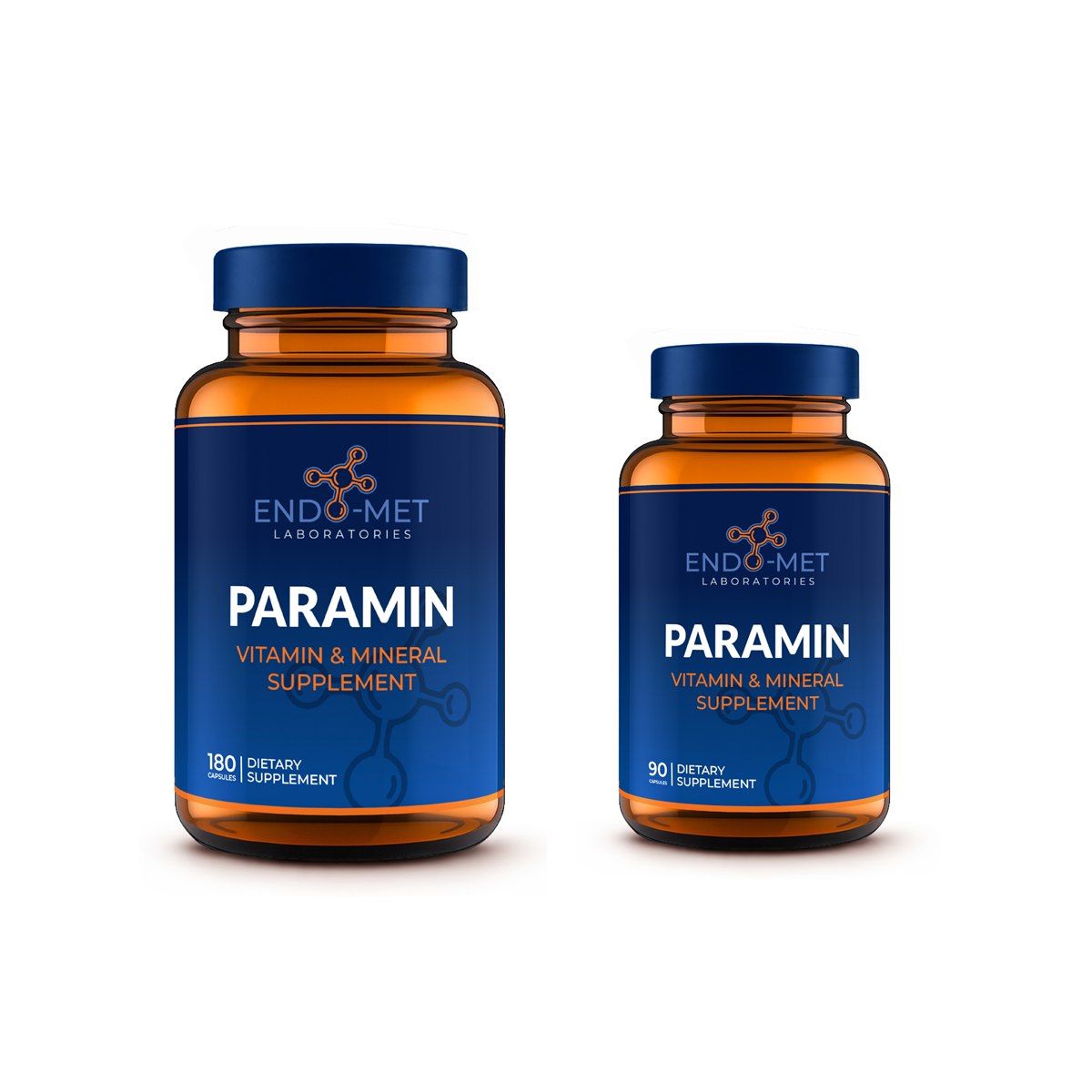
Endo-met Paramin, in 180-capsule and 90-capsule sizes. The label names the carrier: amino acid chelate alongside a malate, for both the calcium and the magnesium.
Where chelate ranks among the calcium forms
Analytical Research Labs (ARL) ranks calcium supplement forms, and chelate is in its preferred group:
- Preferred: kelp (which supplies calcium with the other minerals needed to use it; ARL cautions that its iodine may be a problem where the pattern shows a hyperthyroid trend), citrate, chelate, gluconate, MCHC (microcrystalline hydroxyapatite), lactate, orotate, aspartate. Bone meal is listed only with the caveat that it must not be lead-contaminated.
- Avoided: calcium carbonate — common chalk, and the form in antacids and coral calcium. ARL notes that carbonate is extremely alkaline and may help the over-acidic, but that reducing stomach acid too much interferes with digestion.
- Also avoided: calcium phosphate, dicalcium phosphate and tricalcium phosphate, because the phosphorus binds the calcium tightly; and any sugared preparation, because sugar upsets calcium metabolism.
Two products can list the same milligrams of calcium in forms from opposite ends of this ranking, for example calcium citrate and calcium carbonate.
What calcium utilization requires
ARL lists these requirements for calcium utilization, whatever the supplement form:
- Hydrochloric acid and chloride. Both are required for calcium utilization.
- Adequate dietary protein. Required for calcium utilization.
- Adrenal hormone levels. Required for calcium utilization. Calcium, magnesium and zinc are ARL's three anti-stress minerals: given as stress buffers, they make the adrenals less responsive to stress, and zinc lowers an excessively high sodium.
Where hydrochloric acid is low, a program can pair minerals with a digestive aid rather than raise the mineral dose.
Which Endo-met formulas are chelated minerals
The single minerals and mineral pairs are listed under Endo-met mineral formulas. Each is indicated for a specific mineral pattern:
- Paramin — calcium with magnesium and boron, used where calcium is wanted in a smaller amount than a metabolic pak supplies.
- Magnesium — one of the primary nutrients for the fast oxidizer, which ARL defines as Ca/K below 4 and Na/Mg above 4.17 (ideal Ca/K is 4 ARL to 4.2 TEI; ideal Na/Mg is 4 TEI to 4.17 ARL). For comparison, the Fast Metabolic Type 1 of Trace Elements, Inc. (TEI), the baseline of its four fast types, is Ca/K below 4.0, Na/Mg above 4.0 and Ca/P below 2.63.
- Zinc — used across almost all metabolic types, in differing amounts.
- Selenium — used where hair selenium reads low, and in relation to an elevated cadmium or mercury reading.
The indication comes from the pattern on a hair test report. The formulas were built around Dr. Paul Eck's approach to mineral relationships.
The other single minerals are indicated as follows. Calcium: the prime indication is fast oxidation, and mixed oxidation where calcium is low relative to potassium. Copper: part of most fast oxidizer programs; it potentiates calcium storage and reduces high potassium. Potassium: a primary nutrient for slow oxidizers; it speeds the metabolic rate, and in a fast oxidizer it can cause nervousness and jitters. Manganese: most slow oxidizers, and small amounts for fast oxidizers, especially those with a low Na/K.
Chelated glandulars are a different family
A chelated glandular is a separate product family from a chelated mineral.
A chelated glandular is a glandular concentrate combined with chelated minerals and supportive vitamins. The chelated part describes the minerals inside it. The glandular concentrate is the reason a formula is chosen: adrenal in Endo-Dren, thymus with adrenal in Thym-Adren, thyroid in Thyro Complex and kidney in Renamide. Four are in regular use, each indicated by a different hair test reading:
- Endo-Dren — adrenal support, used for male slow oxidizers, mixed oxidizers with a sodium/magnesium ratio under 4, and women in slow oxidation with an elevated copper/zinc ratio.
- Thym-Adren — thymus with adrenal, used with a fast oxidation rate and with mixed oxidizers showing an elevated sodium/magnesium ratio.
- Thyro Complex — used with slow oxidation together with a calcium/potassium ratio above 8 to 1.
- Renamide — kidney support, used with elevated cadmium, mercury, nickel or copper, and where the sodium/potassium ratio falls outside roughly 2 to 1 and 10 to 1. Both ends of that range are associated with a kidney stress trend.
Those are trends of the mineral pattern, written the way the laboratories write them on a report. They belong to the pattern, not to the person reading about them, and none of it is a diagnosis.
Where the hair test comes in
A hair tissue mineral analysis shows which minerals are indicated and in what proportion to each other; the supplement form is chosen after that.
Calcium is an example. It is a primary support in fast oxidation, and hair calcium already reads above ideal (40 mg% ARL, 60 mg% TEI) in many slow oxidizers.
A hair test is a screening test, not a diagnostic one. Anything medical belongs with your own licensed provider.
Questions people ask
What does chelated mean on a supplement label?
That the mineral is chemically bound to amino acids, peptides or polypeptides, which hold it in a stable complex. It describes the carrier, not the quality grade.
Which carrier does Endo-met use?
It varies by formula. Zinc and Magnesium use a hydrolyzed rice protein chelate. Selenium is chelated in a vegetable-based medium. Paramin uses an amino acid chelate together with a malate for both calcium and magnesium.
Is a chelate always better than other forms?
It is in the preferred group in the Analytical Research Labs form ranking, alongside citrate, gluconate, MCHC and lactate. The forms that ranking avoids are carbonate, the phosphates and any sugared preparation.
If the form is good, why would absorption still be poor?
ARL lists hydrochloric acid, chloride, adequate dietary protein and adequate adrenal hormone levels as requirements for calcium utilization, whatever the form. Where stomach acid is low, a program can add a digestive aid rather than more of the mineral.
What is the difference between a chelated mineral and a chelated glandular?
A chelated mineral is the mineral itself in a chelated form. A chelated glandular is a glandular concentrate combined with chelated minerals and supportive vitamins, chosen for the gland it supports. Endo-Dren, Thym-Adren, Thyro Complex and Renamide are the four in regular use.
Hair test first, then the supplement form
A hair test report gives the calcium, magnesium, sodium and potassium levels, the trace minerals and the ratios between them; the Endo-met label gives the carrier for each mineral.
Published 2015-04-20 · Updated 2026-09-24
By Eileen Durfee — Practitioner, NBS (Nutritional Balancing Science), NASM-CPT; wellness educator, inventor and author.
These statements have not been evaluated by the Food and Drug Administration. This product is not intended to diagnose, treat, cure or prevent any disease. Hair tissue mineral analysis is a screening test and is not diagnostic; anything medical belongs with your own licensed provider. Wellness Shopping Online is operated by Nuco Enterprise Solutions LLC.