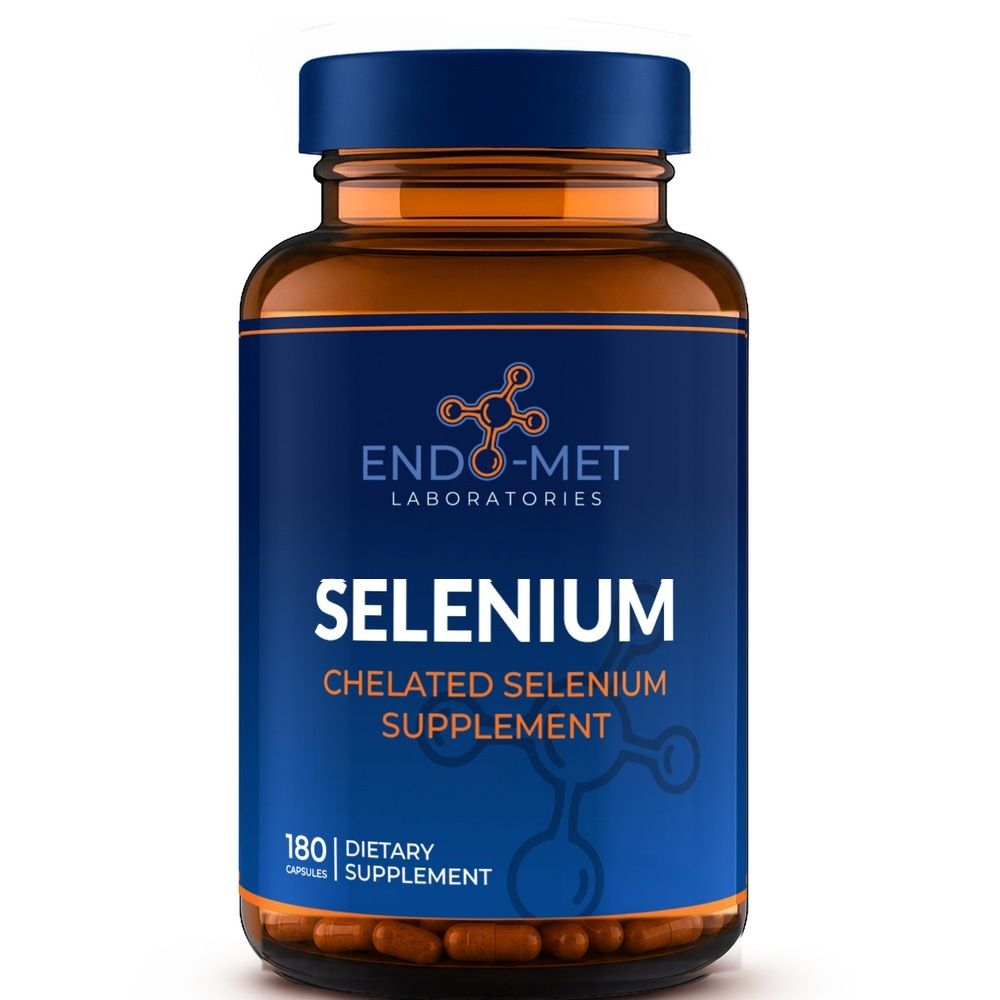
Endo-met Selenium (180 Capsules)
SKU 1086
$35.00
All Oxidation Types
Extended Support with Naturally Chelated Selenium for Detox and Thyroid Health
Estimated delivery time
Shipping: 4–8 days
In stock
Customer reviews
Reviews only from verified customers
No reviews yet. You can buy this product and be the first to leave a review.
Endo-met Selenium (180 Capsules)
Product Details
Brand: Endo-met Laboratories
MPN: SE180
Availability: Shipped same day if ordered M-F by 1 pm PST
Shipping: Calculated at Checkout
Bottle Size: Large (120-270)
Supplied In: Capsules
Oxidation Type: Everyone
Primary Function: Detox
Weight: 0.40 lbs
Endo-met Laboratories
Endo-met Selenium 180 Capsules by Endo-met Labs
Long-Term Detoxification, Thyroid Support, and Mineral Balance
Endo-met Selenium 180 Capsules offer an extended supply of 100 mcg naturally chelated selenium in a nutrient-rich vegetable base, including pea, lentil, and millet powders. This formulation supports detoxification, thyroid function, and immune health, making it ideal for both fast and slow oxidizers. Selenium is essential for antioxidant defense and cellular health, supporting overall vitality and metabolic balance.
Product Highlights
Key Ingredients in Selenium
Endo-met Selenium combines naturally chelated selenium with a vegetable culture base to offer comprehensive detox and thyroid support:
- Selenium (as selenium amino acid chelate): Provides 100 mcg per capsule (143% Daily Value) to aid detoxification, thyroid function, and antioxidant defense.
- Pea Powder, Lentil Powder, and Millet Flour: Sources of additional trace nutrients, preserved through careful drying.
- Chlorophyll (as sodium copper chlorophyllin): Included for added antioxidant support and overall wellness.
Supplement Facts
One Capsule Contains:
- Selenium (as selenium amino acid chelate): 100 mcg (143% Daily Value)
- Pea Powder: 100 mg
- Lentil Powder: 50 mg
- Millet Flour: 50 mg
- Chlorophyll (as sodium copper chlorophyllin): 1 mg
Why Choose Endo-met Selenium 180 Capsules?
Endo-met Selenium 180 Capsules offer a convenient, long-term source of selenium to support detoxification, thyroid health, and immune function. This formulation, with its vegetable culture base, provides additional trace nutrients, making it ideal for those on a Nutritional Balancing Program or anyone looking to enhance their antioxidant intake for comprehensive wellness.
Consultation and Support
If you're considering selenium supplementation, a hair analysis can offer insights tailored to your body’s needs. Contact us at 888-932-2526 for further information.
*These statements have not been evaluated by the Food and Drug Administration. This product is not intended to diagnose, treat, cure, or prevent any disease.
Supplement Facts
Serving size: One capsule · 180 capsules per container
| Per serving | Amount | % Daily Value |
|---|---|---|
| Selenium (as selenium amino acid chelate) | 100 mcg | 143% |
| Pea Powder | 100 mg | † |
| Lentil Powder | 50 mg | † |
| Millet Flour | 50 mg | † |
| Chlorophyll | 1 mg | † |
† Daily Value not established. Other ingredients: Rice flour, gelatin (beef), magnesium stearate.
This formula uses a beef gelatin capsule, so it is not suitable for vegetarians or vegans.
How to read your dosage — the label is not your dose
The bottle says take one capsule a day. That is the generic label default, and it is almost never what a hair tissue mineral analysis actually calls for.
A lab report prescribes a schedule written as three numbers — morning, noon and evening:
| On your report | What it means |
|---|---|
| 1 | One capsule, once a day |
| 1-1-0 | One in the morning, one at noon, none in the evening |
| 1-1-1 | One with each of the three meals |
| 2-1-1 | Two in the morning, one at noon, one in the evening |
| 2-2-1 | Two, two, then one |
| 1-1-2 | One, one, then two — weighted to the evening |
| 3-3-3 | Three with each meal, nine a day in total |
Those are examples rather than a complete list — reports use many combinations, and the amounts are set from your own oxidation rate and mineral ratios. A formula the label treats as a once-a-day supplement may well be prescribed several times a day on a chart, or only in the morning, or not at all.
So do not work out how long a bottle will last from the label. Work it out from your schedule. If you are on 3-3-3, a 180-count bottle is twenty days, not six months.
If you have a report and are not certain how to read it, send it over — walking people through their own numbers is exactly what the text support is for.
What the Endo-met literature says about this formula
What the chart is showing when this is chosen
Selenium is indicated by a low selenium reading, and by cadmium or mercury showing on the chart — it is one of the formulas associated with moving those two particular metals.
Whether it applies to you is read from your own chart rather than from how you feel in a given week. If you have not been tested, that is where the decision starts rather than with a bottle.
Why selenium is chosen from a chart
Selenium appears in the Endo-met literature as relevant where a chart shows cadmium or mercury. It is also one of the elements antagonistic to zinc — which is precisely why single minerals are best selected from a hair analysis rather than added on their own. Raising one element in isolation moves several others.
If you feel worse before you feel better
Nutritional balancing programs sometimes produce what Dr. Paul C. Eck and Dr. Lawrence Wilson called retracing, or a healing reaction. It shows up in one of three ways: an old symptom briefly returns, a current one intensifies for a while, or something new appears and then passes.
Three questions help you tell that apart from something that genuinely needs attention. Are you following a properly designed program? Is the rest of your lifestyle sound — sleep, food, rest? And were you feeling better in the period just before it started?
Cadmium is the classic illustration of why this happens at all. Cadmium has a sodium-retaining effect on the body, so as it is eliminated, sodium falls, the oxidation rate slows, and a person can feel more tired than when they began. It is the point at which people most often quit a program — and, in this framework, the point at which continuing matters most.
From Eileen Durfee
Curated by Practitioner Eileen Durfee, NBS (Nutritional Balancing Science), NASM-CPT — wellness educator, inventor with 10 U.S. and 6 international patents, author, and Nationally Certified Spinal Fitness Specialist
I would rather you did not add this one on your own. Selenium is antagonistic to zinc, so raising it moves other things with it, and the amount that helps one person is not the amount that helps another. Take it because a chart called for it.
I came to hair analysis in 2010, under ARNP Julie Walker in Kennewick, Washington, and worked directly with Analytical Research Labs — testing family and friends until I could read a chart properly. I listened to every cassette tape Dr. Paul Eck recorded and read every newsletter that laboratory published. When I found out a degree in Nutritional Balancing existed, I signed up with Dr. Larry Wilson in August 2011, and I have practised independently since the autumn of 2017. The most useful thing I can offer is not a longer product list — it is help reading your own chart and adjusting between tests. Mineral patterns almost always shift on a retest, and watching that happen chart to chart is where the real learning is. I hand-select the formulas and the absorbable forms that consistently help people feel and function better.
How I am available to you. If you order a hair analysis, you get text support from me while you are on the program — retracing and detox questions are best answered as they happen, not weeks later. It takes about three months to train someone to understand what is going on and adjust their own program between tests, and that is the goal. Our Facebook group is free to join whether or not you have bought anything: ask questions there and read through the tips already shared.
I also work in order of priorities, to fit your budget. Some people go all out for longevity; others take only what their hair analysis calls for, once a day. Both are worth doing. Tell me where you are and we will start there.
Matched to your chart. Endo-met formulas are designed to be selected from Hair Tissue Mineral Analysis results rather than chosen from symptoms, because the same product can suit one oxidation pattern well and another poorly. If you are unsure whether this one fits you, a hair analysis answers that from your own numbers.
Common questions
How does selenium deficiency affect the immune system?
The Importance of Selenium for Immune Health
Selenium plays a critical role as an antioxidant, playing an essential part in supporting a strong and effective immune system. Insufficient selenium levels can precipitate various detrimental effects on immune performance, significantly compromising the body’s defense mechanisms.
- Impaired Immune Cell Function: When selenium levels are low, the efficiency of immune cells can be compromised. This impairment may lead to a sluggish response to infections, weakening the body's overall ability to fight off harmful pathogens.
- Enhanced Inflammatory Reactions: A deficiency in selenium can elevate oxidative stress and consequently increase inflammation. This heightened inflammatory state can diminish the immune system's effectiveness in resolving infections and diseases.
- Increased Susceptibility to Serious Health Problems: Low levels of selenium have been associated with a greater risk of severe health complications. For instance, patients with conditions such as HIV may experience exacerbated disease progression and higher mortality rates linked to selenium deficiency.
- Benefits of Selenium Supplementation: Fortunately, research has shown that selenium supplementation can bolster immune responses in various health challenges, such as respiratory infections like influenza, as well as chronic conditions like hepatitis C. Individuals taking selenium supplements may witness improved health outcomes and reduced rates of hospitalization during these health crises.
In summary, maintaining suitable selenium levels is vital for ensuring robust immune function, while a deficiency can lead to diminished immunity and significant health risks.
What should I know about not taking too much selenium?
Selenium is worth respecting because the gap between an adequate intake and an excessive one is narrower than it is for most nutrients. The commonly cited upper limit for adults is 400 mcg per day from all sources combined.
When intake runs high over time, the body tends to signal it in recognisable ways: a garlic-like odour on the breath, a metallic taste, brittle hair and nails, hair thinning, skin rash, digestive upset, or irritability. None of these are subtle once you know to look for them.
Food sources deserve a mention here. Brazil nuts are extraordinarily variable — selenium content depends on the soil the tree grew in, and a single nut can range from modest to several times a day’s worth. Eating them by the handful daily is the most common way people quietly overshoot.
This is one of the clearest arguments for testing rather than estimating. A hair tissue mineral analysis shows where your selenium actually sits, so the amount you take can be matched to your own numbers instead of to a general recommendation.
How does selenium support cognitive health as we age?
Brain tissue is lipid-rich and metabolically demanding, which makes it a place where the body invests heavily in managing oxidative stress. Selenium is central to that work, because it is built into the selenoprotein enzymes — glutathione peroxidase and thioredoxin reductase among them — that keep peroxides in check inside the cell.
The brain also holds on to selenium comparatively well when intake falls, which researchers generally read as a sign of how much the tissue depends on it.
Selenium therefore supports normal antioxidant function and normal cognitive function as part of an adequate diet. It is worth being straight about the limits of that statement: much of the human research here is observational, and an association between selenium status and cognitive measures is not the same thing as a demonstrated effect. If cognition is something you are actively thinking about, your healthcare provider can help you look at the whole picture, of which nutrient status is one part.
How does selenium support the body’s antioxidant defenses?
Selenium does not work the way vitamin C or vitamin E does. Those act as antioxidants directly. Selenium instead gets incorporated into roughly twenty-five selenoproteins — enzymes that carry a selenium atom at their active site and cannot do their job without it.
The two best characterised are glutathione peroxidase, which reduces hydrogen peroxide and lipid peroxides to harmless products before they can damage membranes, and thioredoxin reductase, which helps maintain other antioxidant systems in their active form and is involved in normal DNA synthesis and repair.
This is why selenium status has an outsized effect relative to how little of it the body holds: it is not being consumed as a buffer, it is enabling enzymes that work catalytically.
Selenium also has an important relationship with the toxic metals. In the Endo-met literature it is one of the elements associated with cadmium and mercury, and it is antagonistic to zinc — which is precisely why single minerals are best selected from a chart rather than added on their own.
Selenium supports normal antioxidant function and normal immune function as part of an adequate diet.
What are the best dietary sources of selenium?
Top Dietary Sources of Selenium: Nourishing Foods to Include
Selenium is an essential mineral that plays a significant role in various bodily functions, and fortunately, it can be found in a variety of tasty foods. Here’s a list of the best dietary sources of selenium to consider incorporating into your meals:
Oysters: Selenium Superstars
A small serving of just 3 ounces (85 grams) of oysters provides a remarkable 238% of your daily value (DV) for selenium, making them a top choice for fulfilling your selenium requirements.
Brazil Nuts: Nutrient-Dense Powerhouse
With only one nut (5 grams), Brazil nuts can deliver approximately 174% of the DV for selenium, showcasing their potency as a healthy, convenient snack.
Halibut: A Protein-Rich Source
A 6-ounce (159 grams) serving of halibut offers around 171% of the DV for selenium, providing an excellent source of this mineral along with high-quality protein.
Yellowfin Tuna: Selenium-Rich Fish
A 3-ounce (85 grams) serving of yellowfin tuna contains approximately 167% of the DV for selenium, making it an easy way to incorporate this mineral into your diet.
Eggs: Simple and Versatile
Two large eggs (100 grams) provide about 56% of the DV for selenium, making them a versatile and nutritious addition to any diet.
Sardines: Compact Nutrient Source
Four pieces (48 grams) of sardines deliver about 46% of the DV for selenium, offering a concentrated dose of this essential mineral in a small serving.
Sunflower Seeds: A Tasty Snack
A 1-ounce (28 grams) serving of sunflower seeds provides 27% of the DV for selenium, making them a healthy and convenient option for snacks or meal toppings.
Chicken Breast: Lean and Nutritious
Four slices (84 grams) of chicken breast can offer around 12% of the DV for selenium, providing a lean protein source that is also rich in this important mineral.
Shiitake Mushrooms: A Flavorful Addition
One cup (97 grams) of shiitake mushrooms contains about 10% of the DV for selenium, making them a nutritious and flavorful choice to enhance a variety of dishes.
Incorporating these selenium-rich foods into your diet can help ensure you meet your nutritional needs while enjoying a wide range of flavors and health benefits. Whether you choose seafood, nuts, or fruits, there are many delicious options to explore!
How does selenium support circulation and cardiovascular health?
The mechanism is the same selenoprotein chemistry described above, applied to a particular tissue. Blood vessel walls and the lipids circulating through them are exposed to continuous oxidative pressure, and lipid peroxidation is one of the processes glutathione peroxidase exists to limit.
Selenium also works closely with vitamin E. The two are complementary rather than interchangeable: vitamin E intercepts free radicals within the membrane itself, while selenium-dependent glutathione peroxidase clears the peroxides that form. A shortfall in one raises the demand on the other, which is part of why nutrients are better assessed together than one at a time.
Selenium supports normal cardiovascular function and healthy circulation as part of an adequate diet. If you are managing your cardiovascular health with a clinician, they are the right person to fit nutrient status into that plan — and it is worth telling them what you take, since selenium interacts with several other nutrients.
How does selenium support healthy respiratory function?
Lung tissue and the fluid lining the airways sit at the boundary between the body and everything it breathes in, which makes them a site of sustained oxidative exposure. Selenium-dependent glutathione peroxidase is present in both, and this is the basis of selenium’s connection to respiratory tissue.
Selenium supports normal respiratory function and normal immune function as part of an adequate diet.
If you have a diagnosed respiratory condition, please keep your provider in the loop rather than treating a supplement as an alternative to what they have advised. Nutrient status can be one useful piece of the picture, and a hair tissue mineral analysis is a straightforward way to see where yours sits.
Which Dietary Restrictions Does Endo-met Supplement Accommodate?
Summary of Allergens and Sensitivities
What are the key considerations for safe and effective use of Selenium?
Guidelines for Using Endo-Met Supplements
Endo-Met supplements should be used according to personalized recommendations derived from individual HTMA (Hair Tissue Mineral Analysis) laboratory results. These supplements are considered safe for use during pregnancy. However, those who are breastfeeding should undergo an additional HTMA test to receive tailored recommendations from a qualified Health Practitioner specializing in Hair Analysis.
Supplementation Guidelines
The dosage of Selenium in Endo-Met supplements typically varies based on individual needs as determined through HTMA assessment. Generally, the recommended daily intake ranges from one (1) to three (3) capsules, taken two to three times daily with meals. For optimal and safe use, it is advisable to consult a Health Practitioner knowledgeable in Hair Analysis. If an HTMA test is unavailable, please follow the dosing instructions provided on the supplement packaging.
What are the key considerations for supply duration and flexibility with Selenium supplements?
A single bottle of Selenium contains 180 capsules, providing a supply duration ranging from 30 to 180 days. The exact duration largely depends on individual usage requirements and dosage.
Example Supply Durations:
- 30 days: For those consuming 6 capsules daily (2 capsules three times a day), the supply lasts approximately 1 month.
- 60 days: A moderate regimen, such as taking 3 capsules daily (1 tablet three times a day), results in a supply lasting around 60 days.
- 90 days: Individuals using 2 capsules daily may enjoy a supply lasting up to 3 months.
- 180 days: For those consuming just 1 tablet daily, the supply can last up to 6 months.
These supply durations are estimates based on average usage patterns. Your actual supply duration may vary depending on your specific needs and dosage requirements.
What is the future vision for Endo-met Laboratories, and how do they plan to continue advancing health through innovation and scientific research?
Established in 1975 by the esteemed scientist and researcher, Dr. Paul C. Eck, Endo-met Laboratories has committed over four decades to pioneering advancements in nutritional science. The company is dedicated to enhancing individual health and wellness through the development of premium vitamins and minerals, meticulously formulated to meet the unique biochemical needs of each consumer.
Selenium is manufactured by Endo-Met Laboratories, whose formulas were developed around Dr. Paul C. Eck’s approach to mineral balancing. Explore the full line on our Endo-Met supplements page.
Not sure if this is the right formula for you?
Endo-met formulas work best when they are matched to your mineral pattern. A hair tissue mineral analysis shows your levels and toxic element exposure, and the kit is mailed to you with a scale. Or simply call us on 888-932-2526 and ask.
These statements have not been evaluated by the Food and Drug Administration. This product is not intended to diagnose, treat, cure, or prevent any disease. Wellness Shopping Online is operated by Nuco Enterprise Solutions LLC. Your healthcare provider can help you decide what fits your individual situation.
What Customers Say
“It’s easy and they are very helpful i am very grateful to them”
— Thanwa A., 2023 · verified buyer
“But the shipping method took longer than expected,”
— leroy y., 2016 · verified buyer
Reviews collected from verified customers via our previous review platform. Individual experiences vary.